LampStand
Read the Bible deeply. Privately. Anywhere.
A whole study library — four translations, classic commentaries from Calvin to Spurgeon, the confessions, Greek and Hebrew word study — bound into one offline app, with AI exposition that cites real sources and a prayer journal kept in confidence. No account. No analytics. Nothing leaves your device.
Free, with no subscription — designed and built slowly, by Amphora.
Most Bible apps treat Scripture like a content feed
Streaks, badges, notification nudges, social sharing, an account before you read a single verse — the mechanics of an engagement app wrapped around the Word of God. We think the text deserves the opposite: typography held to the standard of a finely printed page, tools that go deep instead of wide, and software quiet enough to disappear behind what you came to read.
A stranger opens it and feels drawn to look at Scripture anew — to understand things they have read before in ways they did not. Someone who has never read the Bible feels this is a place to start.
That paragraph governs every decision in the codebase. The authority of Scripture supersedes any feature list — but modern tools can help unpack the Word in ways that simply weren’t possible before. Only the Holy Spirit opens eyes; this app can soften calcified eyelids.
The whole study, in your hands
From the morning’s first verse to a question that surfaces at midnight — reading, word study, grounded exposition, and a place to pray, gathered into one quiet, unhurried place.
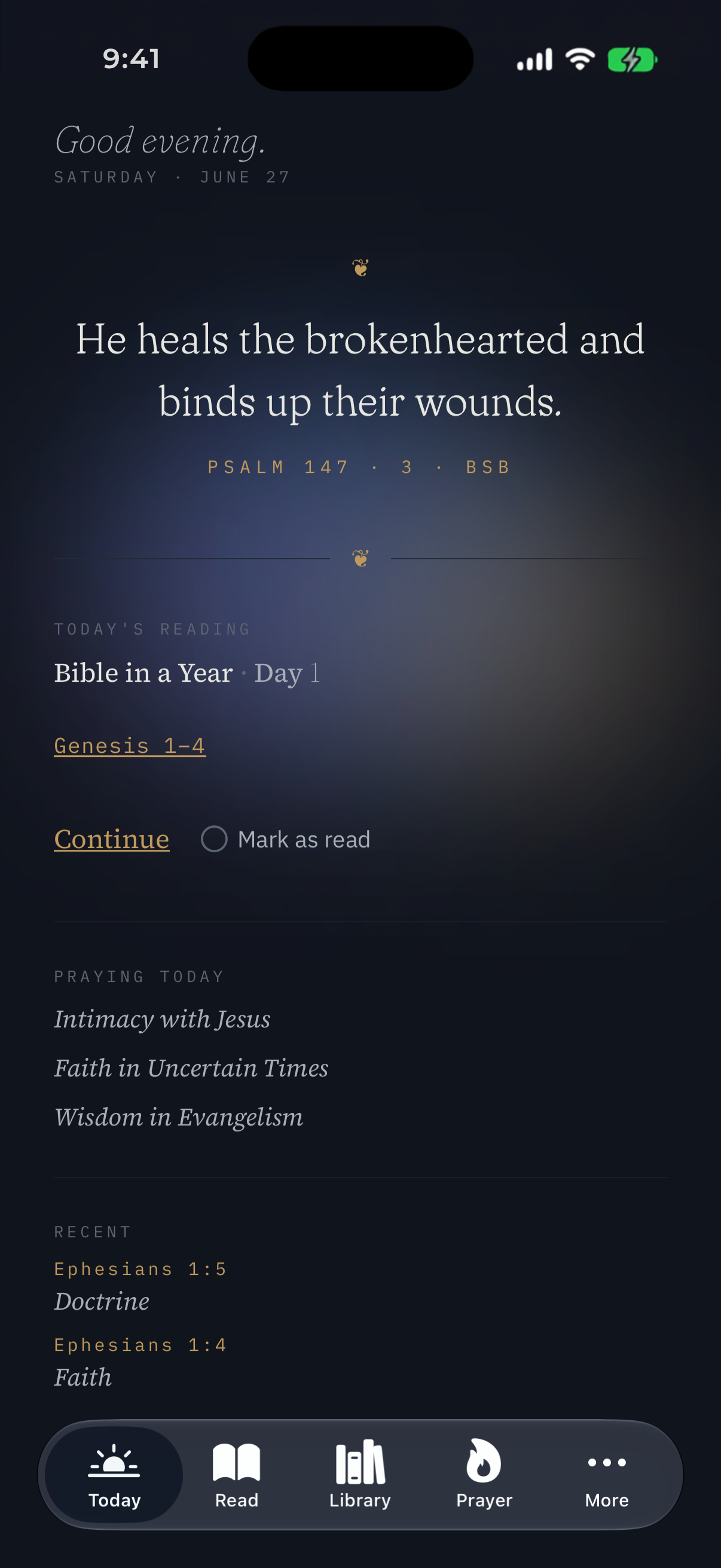
A quiet place to start the day in the Word — a verse to sit with, your reading plan ready, and the people and burdens you’re praying over, gathered in one calm view. An on-ramp back into Scripture, not a feed to scroll.
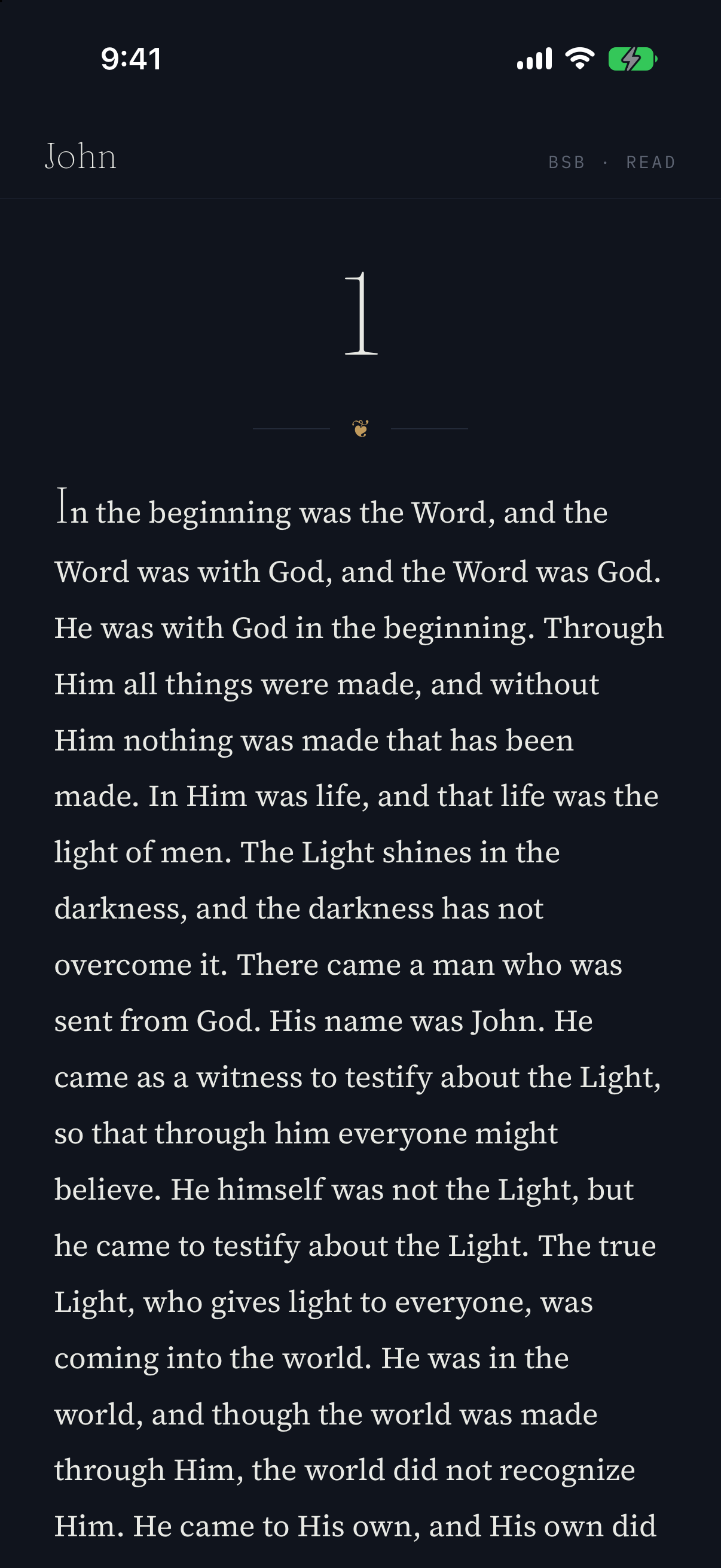
Scripture to be read, not skimmed. Four translations, clean and uncluttered, with no ads or notifications pulling at your attention — so you can linger over a chapter and let the Word do its quiet work.
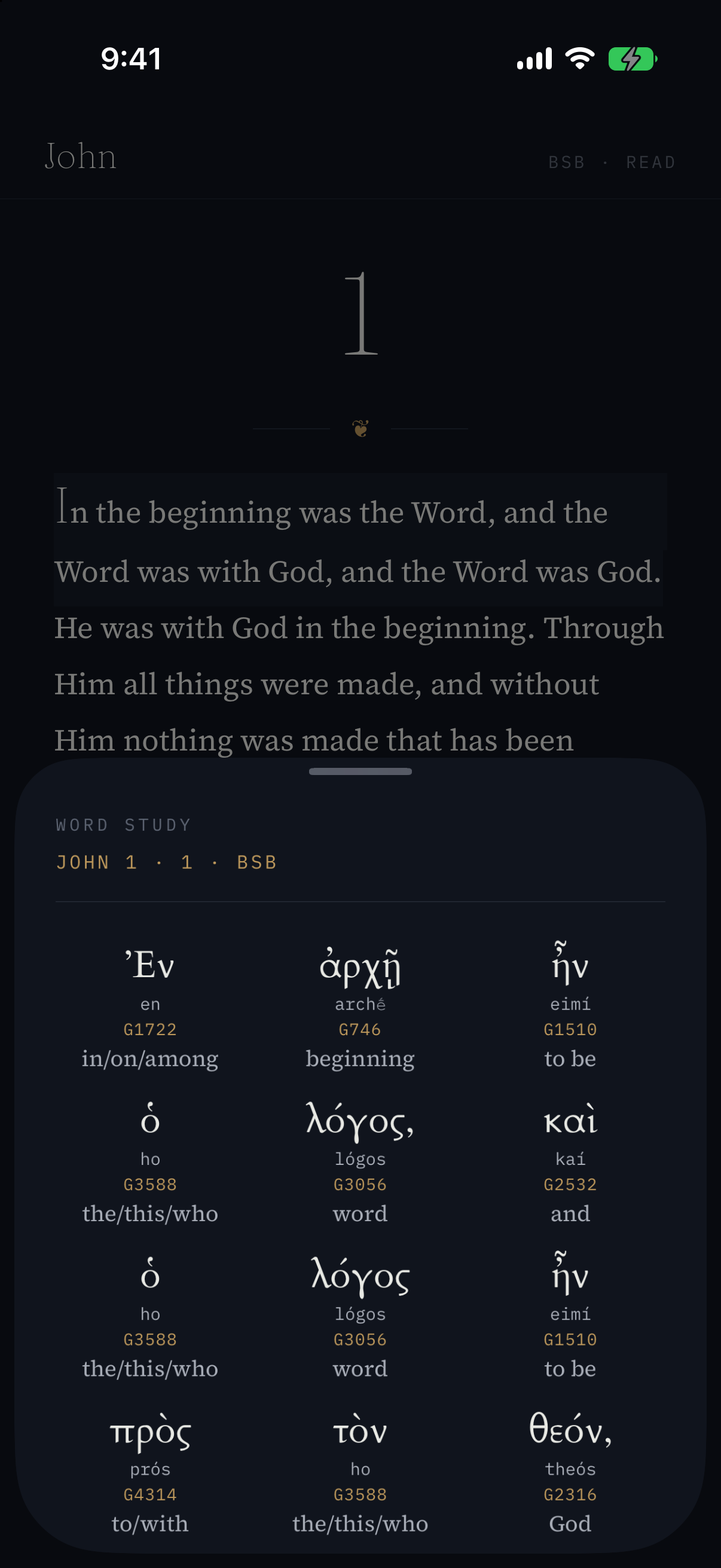
Tap any word and the original Greek or Hebrew opens beneath it — lemma, Strong’s number, lexicon gloss, morphology, and every other place that word appears. No seminary login required.
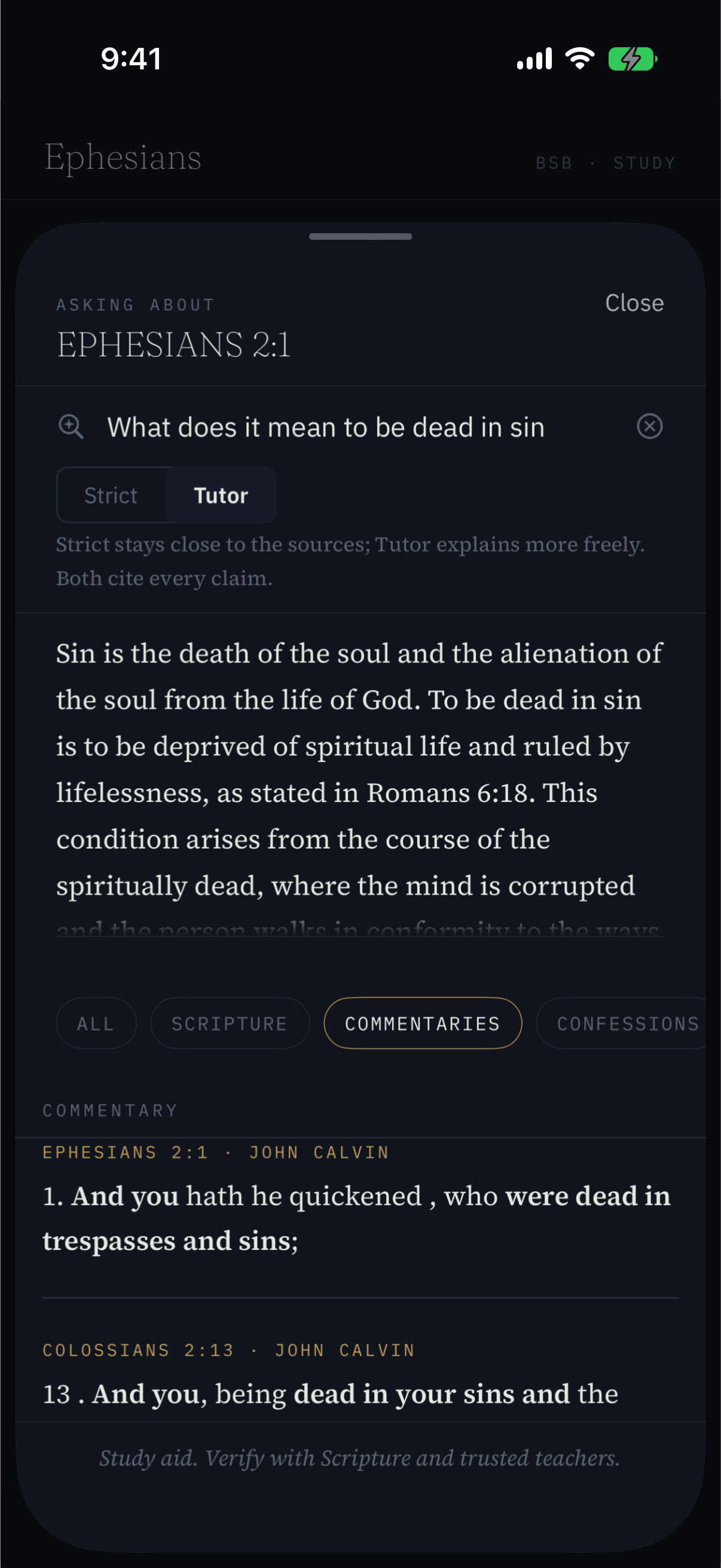
Ask about the passage you’re reading and the answer is drawn from the curated corpus — with real, tappable citations into Calvin, Matthew Henry, the confessions, and Scripture itself.
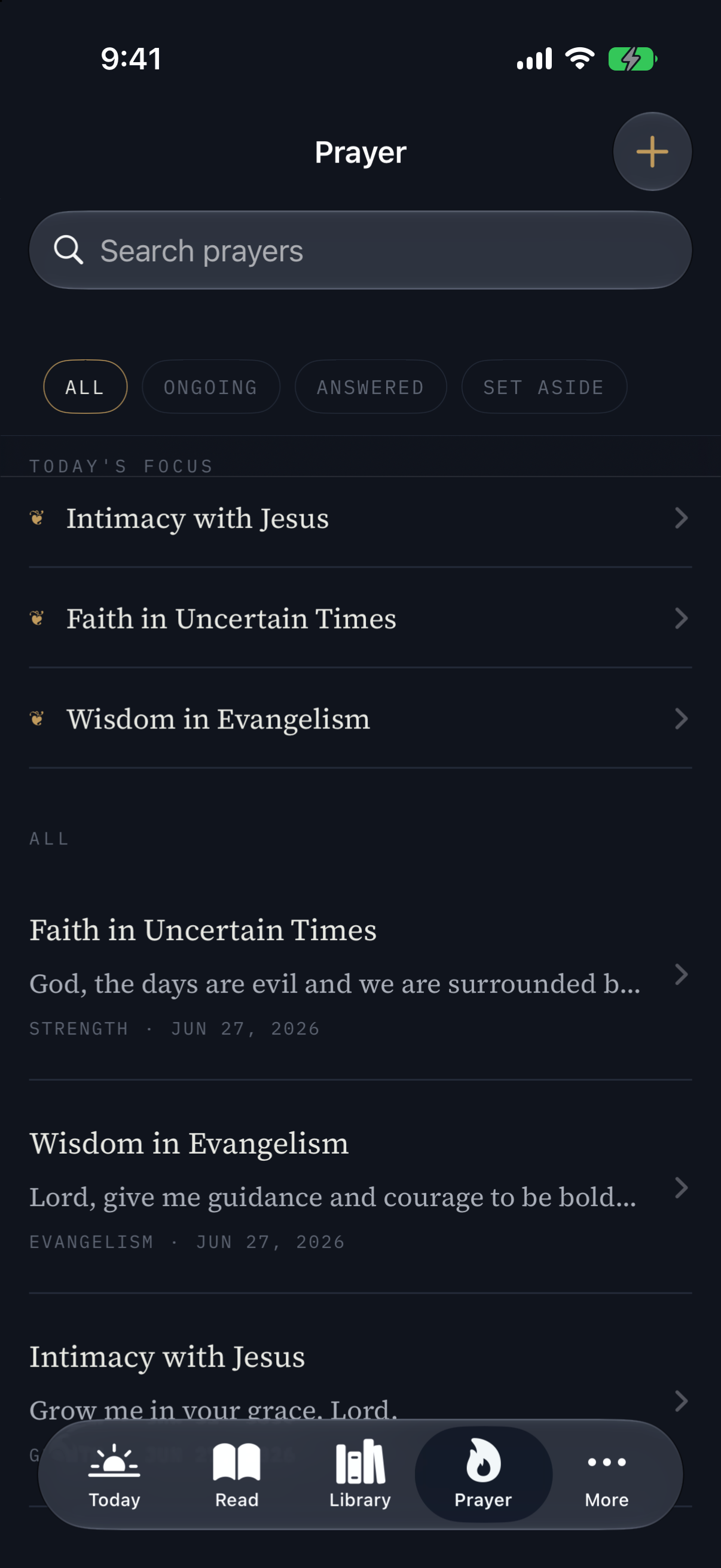
A private journal for whatever is on your heart. Bring your requests, return to them over time, and mark them answered when God moves — keeping, week by week, a record of His faithfulness you can look back on.
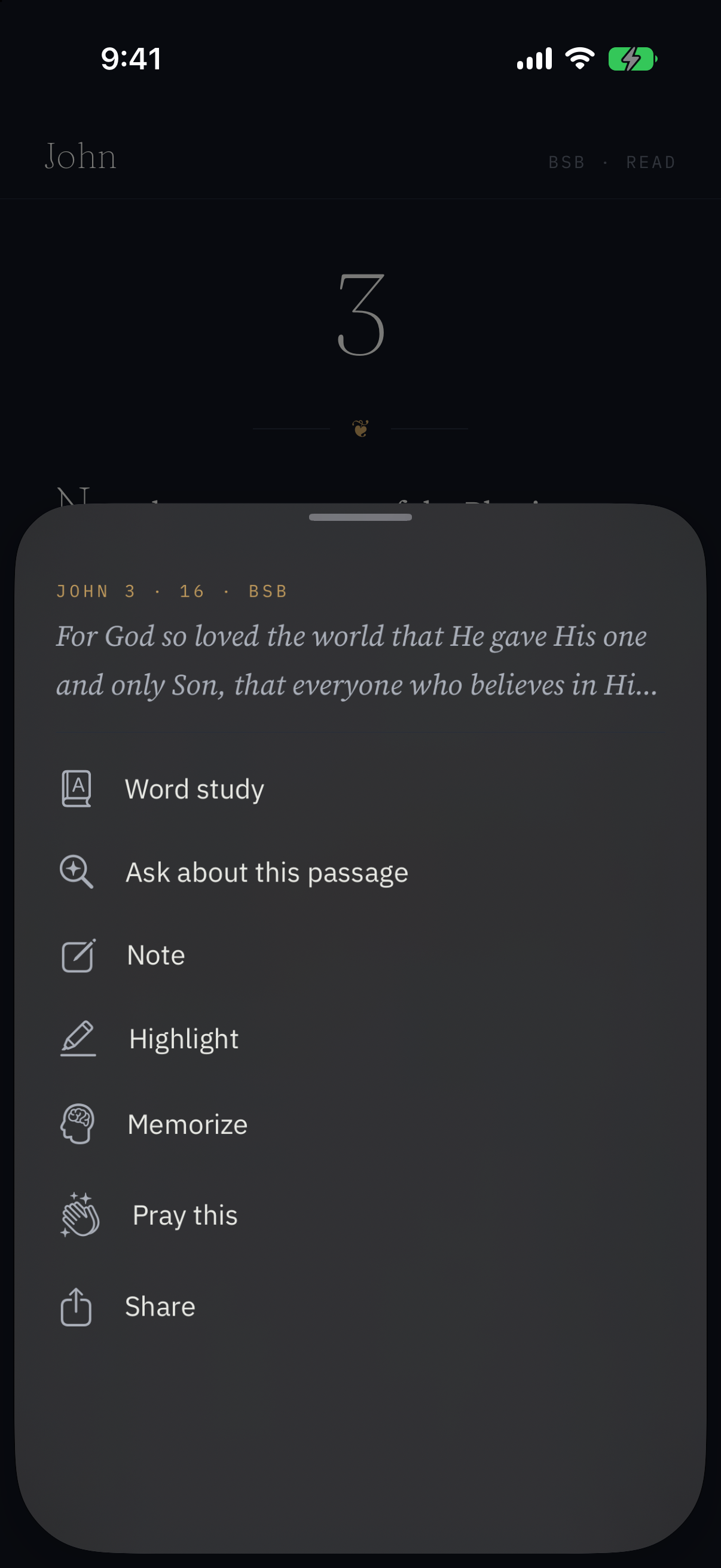
Select a verse and a frosted sheet floats up — Scripture stays legible through the material. Cross-references, word study, commentary, notes, highlights, and a question box, one tap away.
Three themes at ship · Moonlight (default) · Candlelight · Paper
Grounded, not generated
LampStand’s intelligence is a cascade. Each question is answered at the lowest tier that can do it justice — and every tier draws its answer from the same curated shelf, never from a model’s open imagination. The soul of the app is the grounding: real sources, real citations, and an honest “the sources don’t address that” when they don’t.
Retrieval
A hybrid search engine — dense embeddings plus BM25 keyword ranking — runs entirely on your phone over the curated corpus. It finds the passages, commentary, and confession articles that actually bear on your question. This is the substrate everything else stands on.
On-device reasoning
Apple’s on-device Foundation Model composes the retrieved sources into a plain-language answer — without a single byte leaving your phone. For most questions, this is the whole story: private by physics, not by policy.
The harder questions
When a question needs more, it escalates to Apple’s server model on Private Cloud Compute — stateless by design, so your question is never retained. No account, no identifier, no third-party AI vendor in the loop.
The library is on your device. It works on a plane, at a cabin, in a basement with no signal.
Notes, highlights, and prayers live in an encrypted store keyed from the Secure Enclave — never in plain files.
Every claim cites a shortcode that opens the exact source. A fabricated reference is an architectural impossibility.
A study shelf that ships in your pocket
Roughly 175,000 passages, commentary sections, confession articles, and lexicon entries — built from canonical, public-domain sources, normalized through an open pipeline, and theologically curated. Nothing is added to it silently.
When you ask a question, the AI answers from this shelf — and only this shelf — citing the exact passage, confession article, or commentary section it drew from. If the sources don’t address it, it says so rather than inventing references.
The pipeline is open source on purpose: anyone can verify exactly how the texts are sourced, normalized, and processed. Cross-reference data courtesy of openbible.info (CC-BY); original-language data from STEP Bible (CC-BY).
Berean Standard Bible, King James, American Standard, World English — four full texts, every verse.
Calvin, Matthew Henry, Jamieson-Fausset-Brown, and Spurgeon’s Treasury of David on the Psalms.
The Westminster Standards, the 1689 London Baptist, Heidelberg, Belgic, and the Canons of Dort.
Strong’s Greek & Hebrew, Brown-Driver-Briggs, morphology tagging, and word-by-word tagged text.
The Treasury of Scripture Knowledge — roughly 340,000 weighted connections between verses.
Tools that go deep, not wide
Read
Four translations set with the typographic care of a printed page — drop caps, pericope titles, lining-figure numerals, and words of Christ in muted carmine.
Word study
Greek and Hebrew under every word: lemma, Strong’s, lexicon gloss, morphology, and concordance — the original languages without the seminary gate.
Ask
Grounded exposition that cites real, resolvable sources and refuses to invent them. Every answer carries the same footer: a study aid, to verify with Scripture and trusted teachers.
Prayer journal
A private record of requests and answers, encrypted at rest. Mark one answered and the light blooms once — the only ceremony the app keeps.
Reading plans
Bible-in-a-year and themed plans as quiet templates you choose — never streaks engineered to shame you back.
Memorization
Spaced review to hide the Word in your heart, with a graduation beat when a verse is truly learned.
Three themes
Moonlight (lapis dark, the default), Candlelight (amber dark), and Paper (light) — all first-class, gilt constant across each.
Cross-references
Follow the Treasury of Scripture Knowledge from any verse, letting Scripture interpret Scripture across the whole canon.
Your reading life is none of our business
What you read, what you pray, what you wonder about at midnight — that belongs to you and to God, not to an analytics dashboard. These aren’t settings you toggle. They are architectural commitments; the app is built so that breaking them is impossible, not merely discouraged.
- No accounts. No email signup, no profile — nothing to create or remember.
- No analytics SDKs, no telemetry, no crash reporters phoning home. None.
- Notes, highlights, and prayers are encrypted at rest on your device.
- Zero background network activity. When you’re not using it, it’s silent.
- No ads, no streaks, no badges, no engagement mechanics of any kind.
- No tracking-permission prompt — because there is nothing to track.
Free, with no subscription
Scripture, the full study library, the three themes, word study, and grounded exposition are all free — nothing is held behind a paywall. The only purchase is an optional, non-blocking patronage: a quiet way to say thank you that gates nothing. No ads, ever.
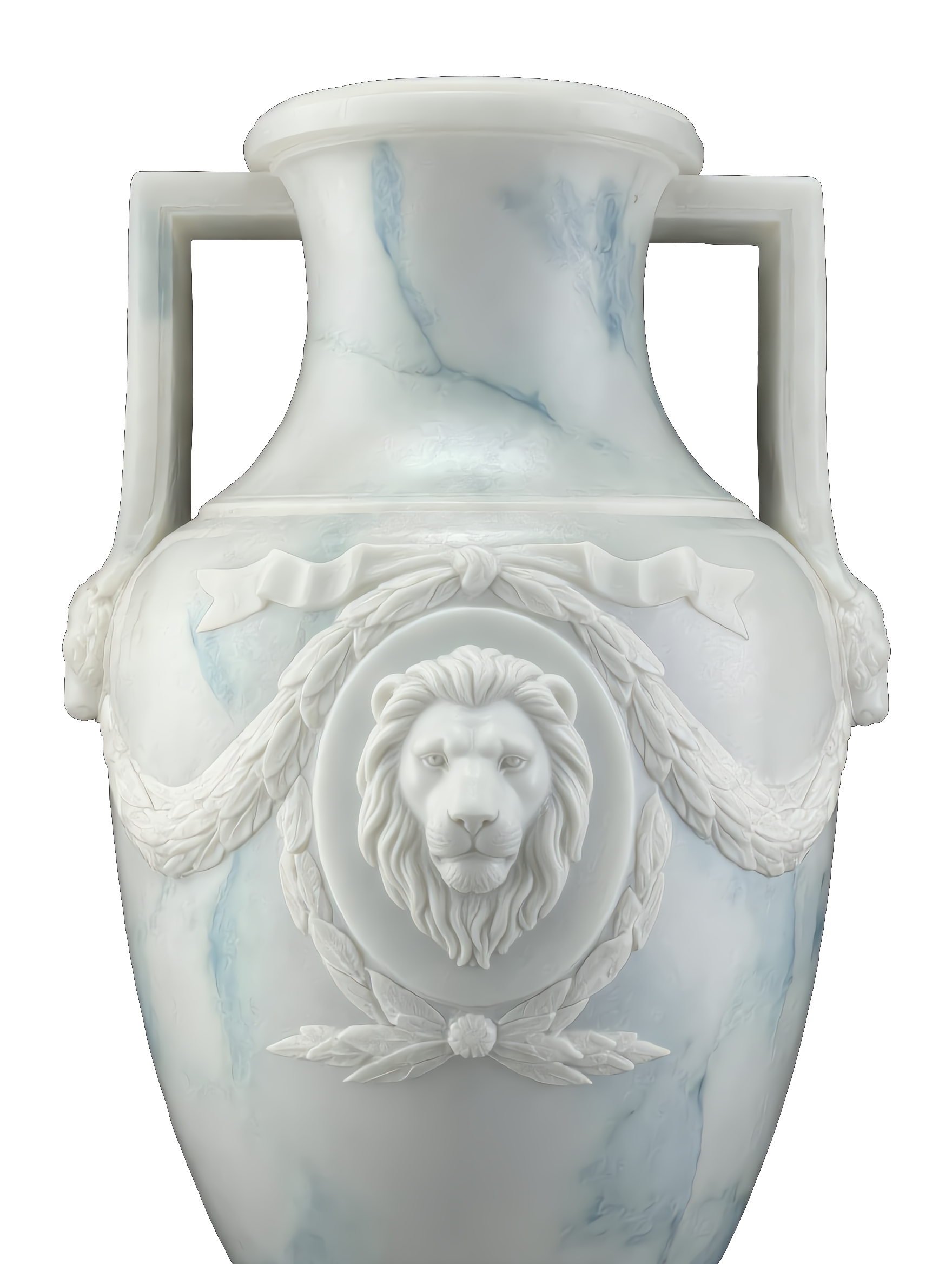
Lit soon
LampStand is designed and built by Amphora — slowly, and with care. The app is currently in beta, in the hands of a small group of pastoral advisors and lay readers reviewing the theological accuracy of its citations and retrieval intelligence.
If you’d like a single quiet note when it reaches the App Store, write and say so.
hello@thelampstand.app“The lamp of the body is the eye. If then your eye is good, your whole body will be full of light.”